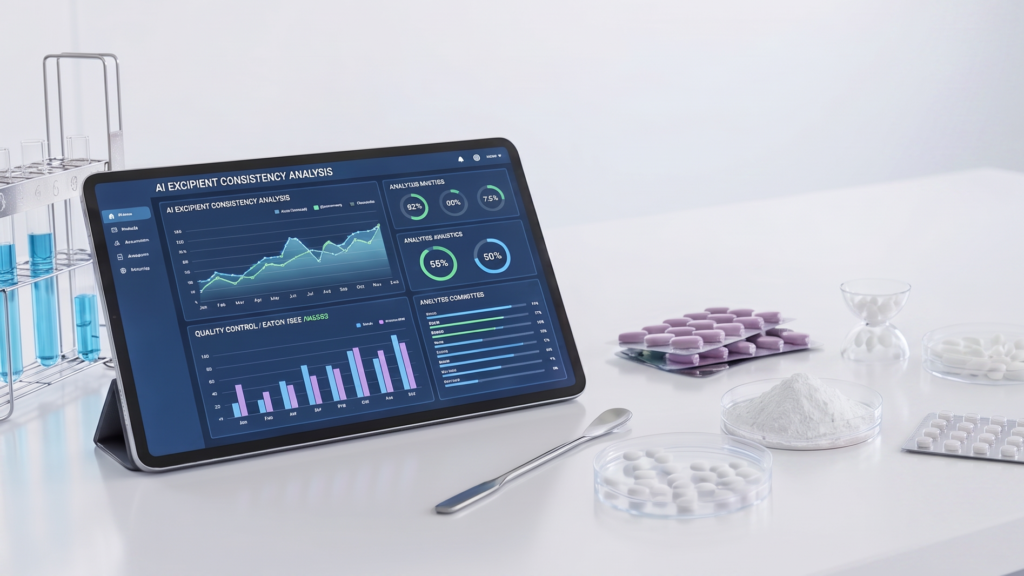

Pharmaceutical Lactose in Oral Solid Dosage Forms: Grade Selection, Functional Contribution and Development Considerations
In oral solid dosage forms, lactose is often described as a filler. This description is accurate, but it can be incomplete. Depending on its grade, particle size distribution and physicochemical characteristics, pharmaceutical lactose can contribute to several formulation parameters, including blend behaviour, tablet structure, disintegration and the conditions in which an API becomes available for dissolution.
Lactose does not generally modify the intrinsic solubility of an API. It should not be presented as a direct bioavailability enhancer. However, in immediate-release oral solid dosage forms, it may help create a formulation environment that supports reproducible disintegration and dissolution, when the grade is selected appropriately and validated through development studies.
Why excipient selection matters in oral solid dosage forms
Oral solid dosage forms remain a central route for drug administration because they can support accurate dosing, industrial scalability, patient acceptability and product stability. Their performance depends on a sequence of events: the dosage form must disintegrate or release the API, the API must dissolve under relevant physiological conditions, and the dissolved fraction must become available for absorption, depending on the permeability profile of the molecule.
Within this sequence, excipients are not selected only to complete tablet mass. They also contribute to manufacturability, mechanical resistance, disintegration, flow, compaction and, indirectly, dissolution behaviour. This is why excipient selection is part of the galenic strategy, alongside API properties, dose, route of administration and target release profile.
For APIs with limited aqueous solubility (cf articles on Excipients & dissolution), formulation decisions become particularly important. The formulation cannot change the fundamental chemistry of the molecule, but it can influence the environment in which the API is dispersed, wetted and exposed to gastrointestinal fluids.
What pharmaceutical lactose can contribute in an oral formulation
Pharmaceutical lactose is widely used in oral solid dosage forms as a diluent or filler. In some grades and processes, it may also contribute to binding and compaction behaviour. Its role is therefore connected both to the physical architecture of the tablet and to the reproducibility of the manufacturing process.
Several characteristics explain its relevance in oral solid dosage formulation.
A water-soluble excipient supporting matrix opening
Lactose is a water-soluble excipient. Once water penetrates the dosage form, lactose dissolution can contribute to the formation of aqueous pathways within the tablet matrix. This may support disintegration and exposure of the API surface to gastrointestinal fluids. The effect remains indirect and formulation-dependent, but it is relevant when considering dissolution performance in immediate-release systems.4
A relatively low-hygroscopic material under standard conditions
Alpha-lactose monohydrate is generally described as relatively non-hygroscopic under standard storage conditions. This property may be useful when formulating with APIs that are sensitive to moisture, although the final stability profile must always be assessed through ICH-aligned stability and compatibility studies. Any comparison with other excipients such as MCC or mannitol should be based on grade-specific data, because hygroscopicity depends on material form, relative humidity and storage conditions.3,4
A particle-dependent contribution to blend and tablet behaviour
Particle size distribution and morphology can influence how lactose behaves during blending, compression, granulation and disintegration. For low-dose formulations, particle characteristics can also influence content uniformity, especially when the API and excipient particle sizes are not well matched. These parameters are therefore not only analytical descriptors; they can become relevant to process understanding and formulation robustness.
From dissolution environment to oral performance: a careful distinction
A clear distinction should be maintained between solubility, dissolution and bioavailability.
Solubility is primarily a thermodynamic property of the API. It refers to the maximum amount of API that can dissolve under defined conditions, including pH and temperature.
Dissolution is a kinetic process. It describes the rate and extent to which the API enters solution from the dosage form under relevant conditions.
Bioavailability is the fraction of the administered dose that reaches systemic circulation. It depends on several factors, including dissolution, permeability, metabolism and physiological conditions.
Lactose is most appropriately discussed at the level of formulation behaviour and dissolution conditions. It may contribute to tablet disintegration, API exposure and reproducibility of the matrix environment, but its effect on bioavailability remains indirect and must be assessed in the context of the complete formulation and API properties.1,2
This distinction is relevant from both a regulatory and a scientific perspective, as it supports accurate representation of the excipient’s role in oral solid dosage form development.
Batch-to-batch consistency: why supplier reliability matters
In pharmaceutical development and manufacturing, reproducibility is central. A formulation that performs well at laboratory scale must remain consistent during scale-up, transfer and routine production. Excipient consistency can support this objective by reducing one source of variability in the formulation system.
For pharmaceutical lactose, several material attributes may be relevant depending on the dosage form and process:
- particle size distribution;
- crystallinity and amorphous content;
- residual moisture;
- flowability and bulk density;
- compaction behaviour;
- microbiological and pharmacopoeial compliance.
Variability in these parameters may influence blend behaviour, compression performance, disintegration and dissolution profile. The magnitude of the impact depends on the API, formulation design and manufacturing process. This is why a well-characterized lactose grade, supplied with consistent quality documentation, can contribute to a more controlled development and production framework.
In a regulated development environment, excipient supplier consistency can support process continuity, documentation integrity and change control across development and routine manufacturing.
Lactose Grade selection & Galenics
Selecting a lactose grade should be linked to the galenic form, API characteristics, manufacturing process and target performance. Lactose is not a single functional material. Different grades are designed to support different formulation routes.
Milled and sieved alpha-lactose monohydrate

Milled and sieved alpha-lactose monohydrate grades are commonly used in wet granulation, dry granulation and dry blending applications. These grades can help formulators adjust particle size, blend behaviour and tablet matrix characteristics.
However, standard milled and sieved alpha-lactose monohydrate is not usually selected for direct compression without a granulation step, because its compactibility is generally lower than that of grades specifically engineered for direct compression.
Spray-dried, anhydrous and granulated lactose for direct compression
For direct compression, formulators generally consider lactose grades designed to provide improved flowability and compactibility, such as spray-dried lactose, anhydrous lactose or granulated lactose. These grades may support direct compression by improving tablet mechanical strength, depending on the formulation and process conditions.
Spray-dried lactose, for example, is often selected for its more favourable morphology and compaction behaviour compared with standard milled grades. Nevertheless, content uniformity, API particle size, segregation risk and compression settings should be assessed during development.
Lactose in capsules
In capsule formulations, lactose can be used as a diluent to support fill weight, blend uniformity and powder handling. Depending on the capsule filling process, flowability and particle size distribution may be particularly important. The appropriate grade is typically selected within a range of 60 to 100 Mesh, offering the rheological and compaction behaviour required for consistent capsule production. Grade selection should be guided by the nature and dose of the API**, as well as the bulk density, flow requirements, and manufacturing equipment constraints.
Lactose, MCC and formulation balance
In oral solid dosage forms, lactose is frequently used in combination with other excipients, including microcrystalline cellulose, or MCC. This association can help formulators balance different technical objectives.
Lactose contributes soluble filler functionality and can support matrix behaviour after water penetration. MCC is widely used for its binding and compactibility properties and can contribute to tablet hardness and disintegration behaviour. Used together, these excipients may help balance flow, compression, mechanical strength and disintegration, depending on the formulation.
The lactose-MCC ratio should be defined experimentally. A higher MCC contribution may improve compactibility, while lactose can support soluble filler functionality and, depending on grade, flow and blend behaviour. The appropriate balance depends on the API, dose, process route and target dissolution profile.
This example illustrates a broader principle: lactose grade selection should be considered within the full excipient system. Its performance depends not only on the lactose itself, but also on its interaction with binders, disintegrants, surfactants, lubricants and the API.4
API-excipient affinity and compatibility
The relationship between an API and its excipients is central to formulation development. Physical affinity, particle size compatibility, moisture sensitivity and chemical compatibility can all influence the behaviour of the finished dosage form.
With lactose, compatibility assessment is particularly relevant for APIs that may react with reducing sugars under certain conditions, including some amine-containing compounds. This does not mean lactose is unsuitable in these cases, but it does mean that compatibility studies should be performed before final grade selection. Accelerated stability studies, degradation profiling and formulation screening can help determine whether lactose is appropriate for the specific API and dosage form.4
Compatibility is a development requirement that should be assessed for each API-excipient combination, rather than generalized across all lactose-based formulations.2
Digital tools and AI-supported formulation development
The growing use of data-driven formulation tools may help development teams compare excipient options, anticipate critical material attributes and model formulation behaviour more efficiently. Machine learning approaches are increasingly discussed in drug product development, particularly for identifying relationships between formulation composition, process parameters and product performance.
For excipients such as pharmaceutical lactose, this reinforces the importance of reliable and well-structured material data. Particle size distribution, moisture, flowability, compressibility and grade-specific properties can become valuable inputs for digital formulation models. AI-supported tools do not replace laboratory trials or regulatory validation, but they may help prioritize formulation options and reduce development uncertainty when high-quality data are available.
This is also why supplier documentation and batch-to-batch consistency may become increasingly important as formulation development becomes more data-driven.6
Conclusion
Pharmaceutical lactose is a versatile and reliable excipient, whose contribution to solid dosage formulations — while functional rather than therapeutic — should be neither underestimated nor overstated. In oral solid dosage forms, lactose can contribute to the physical and functional environment of the formulation through its solubility, particle characteristics, grade-specific behaviour and compatibility with established manufacturing routes.
Its contribution to bioavailability is best described as indirect. Lactose may support the conditions required for reproducible disintegration and dissolution, but the final performance of the drug product depends on the API, the complete excipient system, the galenic form and the manufacturing process.
For formulation teams, the most relevant approach is therefore rational grade selection. Choosing the right lactose grade means aligning the excipient with the API, the route of administration, the process and the target product profile. In this context, a consistent and well-documented pharmaceutical lactose supply can support formulation robustness and quality continuity over time. Excipient suppliers can support this process by providing characterized lactose grades with consistent quality documentation and grade-specific technical guidance.1,2
FAQ
What is the role of lactose in oral solid dosage forms?Lactose is primarily used as a filler or diluent, but depending on the grade and formulation, it can also contribute to compaction behaviour, disintegration, powder flow and the environment in which the API becomes available for dissolution.
Does lactose improve API bioavailability?
Lactose should not be described as a direct bioavailability enhancer. It may contribute indirectly by supporting disintegration, API exposure and dissolution conditions in immediate-release formulations. The final effect depends on the API, formulation and process.
Why is particle size distribution important for pharmaceutical lactose?
Particle size distribution can influence flowability, blend uniformity, segregation risk, compaction behaviour and disintegration. Its relevance depends on the dosage form, API dose, manufacturing route and target performance.
When should API-lactose compatibility be assessed?
Compatibility should be assessed during formulation development, especially for APIs that may react with reducing sugars under certain conditions. The decision should be based on stability studies, API chemistry and the intended formulation system.
Sources
- EMA. Guideline on the Investigation of Bioequivalence (CPMP/EWP/QWP/1401/98 Rev. 1). European Medicines Agency, 2010.
- FDA. Guidance for Industry: Waiver of In Vivo Bioavailability and Bioequivalence Studies for Immediate-Release Solid Oral Dosage Forms Based on a Biopharmaceutics Classification System. CDER/FDA, 2017.
- ICH. Q1A(R2): Stability Testing of New Drug Substances and Drug Products. International Council for Harmonisation, 2003.
- Rowe RC et al. Handbook of Pharmaceutical Excipients, 8th edition. Pharmaceutical Press, 2017. Lactose monograph.
- Strickley RG. Solubilizing Excipients in Oral and Injectable Formulations. Pharmaceutical Research. 2004;21(2):201-230.
- Murray JD et al. Advancing algorithmic drug product development: Recommendations for machine learning approaches in drug formulation. European Journal of Pharmaceutical Sciences. 2023;189:106562. DOI: 10.1016/j.ejps.2023.106562.
- Lactalis Ingredients Pharma. Corporate presentation and Lactalpha product information, 2025.