
On the occasion of the publication of the Lactalis Group’s 2025 CSR Report, Lactalis Ingredients Pharma reaffirms its commitment to a sustainable future. Driven by the Group’s new CSR programme, “Our Sustainable Way to Go”, Lactalis is accelerating its local initiatives to combine expertise, quality, and resource preservation.
2025 — A New Momentum: “Our Sustainable Way to Go”
Our CSR ambition is to act responsibly to nourish the future. We work to preserve nature and resources, and to enhance the benefits of dairy products, while empowering our employees, partners, and communities. We build our commitment on our international reach and local presence. Together, in every country where the Lactalis Group operates, it acts to ensure the long-term viability of its activities and the well-being of its employees and future generations.
This new strategy, named “Our Sustainable Way to Go”, is structured around three fundamental pillars that guide all Group operations:
- Preserve nature and its resources
- Strengthen the benefits of dairy products
- Empower our employees, partners, and communities
This CSR programme is designed as a collective action plan for the benefit of the entire Lactalis ecosystem and value chain. It aims to provide teams with a safe and stimulating working environment, to reduce the environmental impact of its operations, to support its partners and dairy farmers in adopting more sustainable practices, and to guarantee its clients a reliable CSR partnership.
Key Lactalis Group Results in 2025
The 2025 CSR Report highlights significant progress across the Lactalis Group on these three pillars. It is worth noting that, for several years now, approximately 15% of the Group’s investments (in €) have been dedicated to environmental projects (energy, water, etc.).
- Climate & Resources: The Group is actively pursuing its decarbonisation trajectory (validated by the Science Based Targets initiative — SBTi) and has recorded a -20.5% reduction in greenhouse gas emissions (Scopes 1 & 2) compared to 2019, moving closer to its interim target of -25% by 2025. Regarding upstream dairy operations, 2025 performance remains positive compared to 2021 (-3.3%), but shows a decline relative to 2024. This trend is primarily attributable to structural factors, including an increase in milk collection volumes in certain countries where we operate.
- Circular Economy: The share of recycled materials incorporated into our packaging has now reached 32.9% (exceeding the >30% target), while 82.2% of our packaging is now recyclable by design.
- Animal Welfare: Animal welfare assessment has progressed significantly, now covering 89.7% of milk volumes collected across the 11 pilot countries.
- Diversity, Equity & Inclusion: The Group continues to promote professional equity, with 28.3% of women in management positions, on track towards the gender balance target set for 2033.
Lactalis Ingredients Pharma and Lactalis Ingredients: A Reliable and Measurable CSR Strategy
At Lactalis Ingredients — the entity to which Lactalis Ingredients Pharma belongs — we translate these strategic orientations into concrete results across our industrial sites, driven by the daily commitment of our teams.

1. Climate: Major Industrial Decarbonisation
Between 2019 and 2025, and through large-scale projects, Lactalis Ingredients has reduced its absolute greenhouse gas emissions (Scopes 1 & 2) by -26.9%. The intensity of its direct emissions has been brought down to 0.36 tonnes of CO₂ per tonne produced (compared to 0.53 in 2019).
The Retiers site — where the Lactalpha range of milled & sieved pharmaceutical lactose is manufactured — has been working for several years on projects aimed at achieving greater energy efficiency. The Retiers site’s decarbonisation ambition is fully aligned with the Lactalis Group’s trajectory, which targets a -46.2% reduction in Scope 1 and 2 greenhouse gas emissions by 2030 — a trajectory validated by the SBTi in 2024.
2. Water Preservation
Sustainable water management is an absolute priority for our processing sites. In 2025, within the Lactalis Ingredients scope, water consumption intensity reached 10.6 m³ per tonne of ingredients produced (down from 11.16 m³ in 2019). To continue progressing further, we are deploying a structured roadmap built around three complementary pillars.
The Retiers site, a pioneer in this area, has implemented a dedicated water policy aimed at reducing its water footprint. This is particularly relevant given that the ingredients produced on site — including pharmaceutical lactose — require significant volumes of water. The successive lactose crystal washing steps are highly water-intensive, as they are essential to achieving the minimum 99.6% lactose purity levels required by applicable pharmacopoeias.
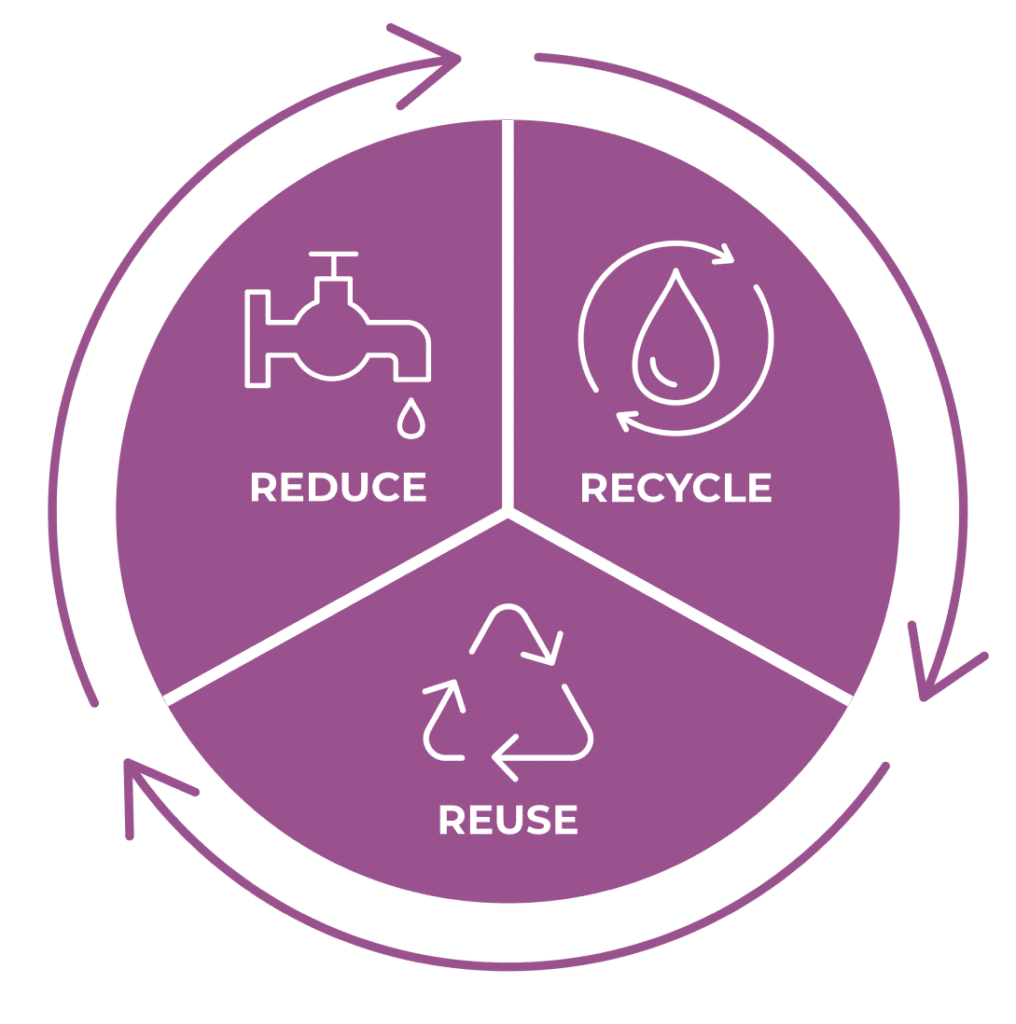
At the Retiers site level, this approach relies on three key levers:
- REDUCE (Optimising manufacturing processes and reducing water abstraction from natural sources): Operations are systematically mapped to identify the most water-intensive workshops and process steps, enabling then to target allocation of efforts and investments. This translates into the optimisation of Clean-In-Place (CIP) cycles — for example through conductivity monitoring (to eliminate unnecessary rinsing phases) — and the installation of next-generation washing technologies that are more water-efficient without compromising sanitary quality standards.
- REUSE (Recovering water derived from milk for internal reuse): Water is both our challenge and our opportunity. Milk, which is inherently a liquid, contains more than 90% water, representing a significant recovery potential. Milk Concentration Waters or COndensate of Whey Water (COWW) — the aqueous condensates recovered during the concentration of liquid milk or whey — are collected throughout the process steps that enable the transition from liquid to solid state, namely the evaporation and concentration stages. These COWW are subsequently reused internally, for example for boiler cooling, filtration membrane washing, or lactose crystal rinsing, thereby reducing reliance on mains or borehole water.
- RECYCLE (Valorising treated effluents): In our on-site wastewater treatment plants, effluents are processed in accordance with strict standards. During periods of high water stress, this recycled water is valorised to supply the site’s cooling towers.
Furthermore, the efficiency of our wastewater treatment plants has improved, with a Chemical Oxygen Demand (COD) load reduced to 0.28 kg per tonne produced (compared to 0.43 in 2019).
All of these actions collectively strengthen our resilience in the face of climate change.
3. Occupational Health & Safety: A Strengthened Prevention Culture
The protection and preservation of our employees’ health are at the core of our operational priorities:
- Reduction in accident rates: The workplace accident frequency rate (FR2) has recorded a steady decline, reaching 21.0 in 2025 (compared to 35.7 in 2019 and 27.5 in 2024). This positive trend is notably driven by improved performance across 8 of our industrial sites and by a reduction in same-level fall accidents.
- Active prevention: Safety culture on the shop floor has been reflected in the completion of 1,770 Workstation Safety Visits in 2025, representing a ratio of 2.18 Workstation Safety Visits per employee, exceeding our internal target of 2.0.
4. Talent Development and Local Engagement
Because sustainable performance is, above all, a human endeavour, Lactalis Ingredients invests in knowledge transfer and employability:
- Professional integration: In 2025, our conversion rate of apprenticeship contracts and internships into long-term employment reached 46%, close to our 50% target for 2026.
- Trainer community: We rely on a solid network of 60 internal trainers to support the skills development of our employees.
Through the implementation of the “Our Sustainable Way to Go” strategy, Lactalis demonstrates that technical expertise and quality standards go hand in hand with environmental and social responsibility. By building more sustainable supply chains, we strengthen the relationship of trust, reliability, and long-term partnership that binds us to our clients around the world.