From Milk to Medicine: 100 Years of Pharmaceutical Lactose continuous improvement
For more than a century, lactose has quietly shaped pharmaceutical formulation and manufacturing [1]. From the first galenic formulations of the 1920s to today’s continuous and 3D-printed manufacturing, this disaccharide—sourced from milk—has become one of the most essential excipients in modern medicine. Its journey mirrors the evolution of pharmaceutical science itself: from empirical compounding to precise, sustainable engineering.
1. The Origins of a Simple Molecule
The story of lactose in pharmacy begins centuries before it became an excipient. Identified as the “sugar of milk” in the 17th century, lactose was formally isolated by Carl Wilhelm Scheele in 1780 [2]. Its molecular structure—composed of glucose and galactose linked by a β-1,4 bond—was later described by Jean-Baptiste Dumas in the 1840s [2], paving the way for its industrial use.At the dawn of the 20th century, this humble disaccharide found new purpose. As pharmaceutical science matured, formulators sought excipients that were inert, stable, and affordable. Lactose, a co-product of the dairy industry, met all three criteria. By the 1930s and 1940s, it was already present in powders and granulates used in early tablet manufacture [1].
2. The Pioneering Era (1950–1960): From Empiricism to Standardization
The pharmaceutical boom of the post-war years brought the first pharma-grade lactose to market. Producers began to purify and crystallize lactose with a level of precision compatible with the emerging pharmacopoeias [1][8]. This period saw the first monohydrate grades, optimized for wet granulation—a major step toward reproducibility and quality control [1].
| Property | Benefit for Formulators |
| Neutral taste | Compatible with oral dosage forms |
| Low hygroscopicity | Good stability in storage |
| Chemical inertness | Compatible with most APIs |
| Natural abundance | Economically sustainable |
These attributes established lactose as the default filler and diluent for oral solid dosage forms (OSD), a position it still holds today [1].
3. The 1960s Revolution: Direct Compression and Spray-Dried Lactose
Before the development of spray-dried lactose, formulators faced a persistent challenge: achieving the right balance between flowability and compressibility—two opposing characteristics often required by different galenic forms [1].This technical tension ultimately led to a turning point in the 1960s, when a milestone innovation arrived: spray-dried lactose (SDL). Produced by atomizing an aqueous suspension of α-lactose monohydrate, SDL combined crystalline and amorphous fractions (typically 85–90 % and 10–15 %, respectively), delivering an unprecedented balance of flowability, compressibility, and binding power [1].This transformation enabled the direct compression (DC) process, eliminating the need for prior wet or dry granulation steps and improving process efficiency while reducing water and energy consumption [1][6]. SDL’s spherical morphology and partial amorphicity allowed uniform die filling and robust tablet integrity [1].Concurrently, the anhydrous β-lactose—produced by roller-drying—offered a solution for moisture-sensitive APIs [1]. In parallel, manufacturers also began offering pre-granulated lactose grades to meet evolving formulation and processing needs [1][6].
4. The 1980s–2000s: The Era of Functional Blends and Process Innovation
As formulation science matured, the 1980s marked a decisive evolution in excipient design. Manufacturers began developing co-processed or functional blends, engineered to enhance the performance of oral solid dosage forms [1][6]. Lactose quickly became the structural backbone of these systems thanks to its proven safety, compatibility, and versatility across multiple manufacturing processes.By combining lactose with complementary excipients such as cellulose, starch, or polymeric binders, formulators achieved greater robustness in direct compression and improved product performance—a key step toward simplified formulation design and more efficient tablet manufacturing [1].A typical tablet formulation often combines six to seven excipients—most commonly lactose, microcrystalline cellulose, and magnesium stearate—each fulfilling distinct roles as filler, binder, or lubricant [1][6]. The development of co-processed excipients aimed to simplify these complex combinations by merging multiple functionalities into a single, optimized ingredient.
| Type of functional blend | Typical components | Primary benefit |
| Lactose–cellulose systems | Lactose + microcrystalline cellulose | Enhanced flowability and compactibility |
| Lactose–starch systems | Lactose + starch derivatives | Faster disintegration and improved mouthfeel |
| Lactose–binder systems | Lactose + polymeric binder | Increased mechanical strength and tablet integrity |
| Multifunctional blends | Lactose + cellulose + starch | Balanced performance for orodispersible and high-load tablets |
These innovations simplified formulation development while reducing the number of excipients required and supporting the emergence of new dosage forms such as orodispersible tablets (ODTs) and high-load direct compression tablets [1].In parallel, lactose’s stability, flow characteristics, and inertness made it an ideal carrier for inhalation therapies, opening new therapeutic possibilities beyond traditional oral routes [1][6].
5. Lactose and Inhalation Therapies
By the 1990s, lactose had become the reference carrier in Dry Powder Inhalers (DPIs). Its crystalline α-monohydrate form offered ideal surface characteristics, ensuring reliable adhesion and detachment of micronized APIs during inhalation [1][6]. Regulatory agencies including the FDA and EMA soon listed lactose as the standard carrier excipient for inhalation powders [6].Innovations in particle engineering followed: controlled jet-milling, surface modification, and even supercritical CO₂ crystallization techniques refined particle size, shape, and electrostatic behavior to optimize aerodynamic performance [6].
6. The 2000s: Quality by Design and Regulatory Maturity
The early 21st century brought a paradigm shift—Quality by Design (QbD). Lactose producers began to characterize their products through Critical Material Attributes (CMAs) such as:
- Particle-size distribution
- Polymorphic form (α/β ratio)
- Amorphous content
- Flow and compressibility indices
[1][7]Simultaneously, Good Manufacturing Practices for Excipients (IPEC–PQG GMP) became the industry baseline, delivering unprecedented batch-to-batch consistency and regulatory confidence in pharmaceutical lactose [7].
7. The 2010s–2025: Smart Manufacturing and Sustainability
Modern engineering has pushed lactose further. Producers now tailor grades for continuous manufacturing and 3D printing [1][6]:
- Granulated DC grades with optimized particle size
- Ultra-fine lactose improving dissolution
- Surface-modified carriers for DPIs
- Self-lubricating lactose grades reducing or eliminating the need for magnesium stearate
Emerging technologies such as pharmaceutical 3D printing have identified lactose monohydrate as a robust and biocompatible substrate [6].Looking ahead, the rise of continuous manufacturing will further reshape excipient selection, making performance consistency and flowability essential criteria—areas where pharmaceutical lactose continues to excel [1].
Sustainability in Focus
Lactose’s DC compatibility inherently lowers energy and water consumption compared with traditional granulation [1].At Lactalis Ingredients Pharma, production at the Retiers site is fully integrated into the Group’s dairy value chain: whey permeate originates from Lactalis cheese plants, ensuring complete traceability and independence from external raw materials [9].Life cycle assessment (LCA) and carbon footprint indicators are likely to become part of excipient selection in the coming years [9].
8. Challenges and Future Directions
The coming decade will test how far a century-old excipient can evolve:
| Challenge | Direction |
| Patient sensitivity | Although pharmaceutical doses of lactose are too low to trigger intolerance symptoms, some formulators explore alternative fillers (such as mannitol or calcium phosphate) or optimized low-residual lactose grades to address specific patient or regulatory requirements. [1][3][4][5] |
| Continuous manufacturing | Highly flowable, consistent lactose DC grades [1][6][7].
|
| 3D printing | Predictive modelling of powder behavior and mechanical strength [6]. |
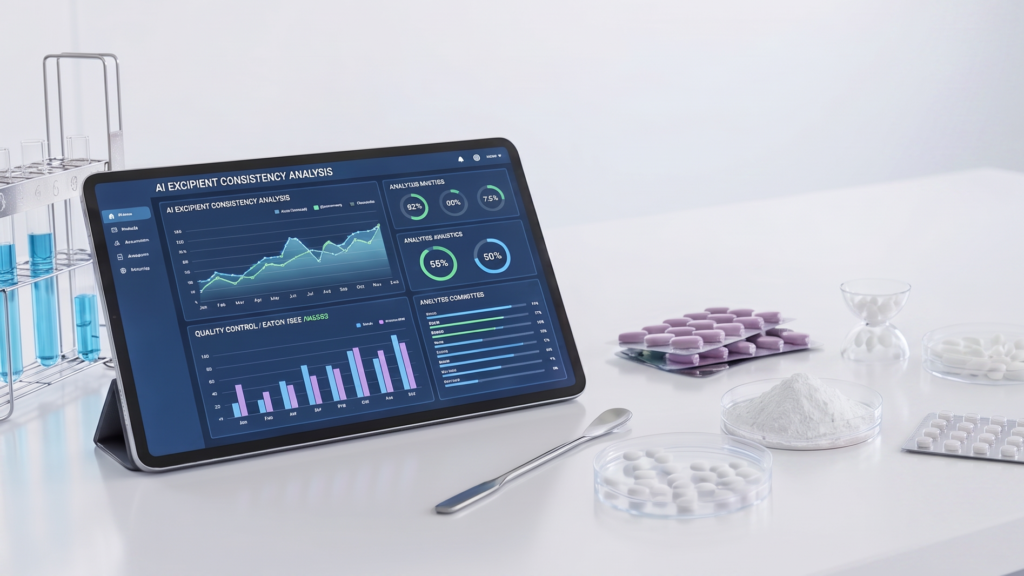
| Digitalization | AI-based prediction of API–excipient compatibility [1]. |
| Environmental footprint | Circular processes and renewable energy integration [9]. |
In parallel, research continues into milk-derived nanocarriers and extracellular vesicles, potentially opening novel therapeutic applications that reconnect lactose with its biological origins.
Conclusion
From a 17th-century curiosity to a 21st-century benchmark of pharmaceutical functionality, lactose has embodied continuous improvement and innovation throughout its scientific and industrial evolution [1].Today, its appeal lies not only in its functional performance but in the complete control of its journey—from milk to medicine. At Lactalis Ingredients Pharma, each particle of lactose embodies the Group’s dual heritage: centuries of dairy expertise and a relentless pursuit of continuous improvement and pharmaceutical innovation [9].It is the story of a natural ingredient refined through precision, trust, and sustainability—a story still evolving with science, technology, and the future of modern medicine.
References
- Dickhoff, B.H.J., & Hebbink, G.A. (2019). Application of Lactose in the Pharmaceutical Industry.
- FrieslandCampina (2019). Lactose: Evolutionary Role, Health Effects, and Applications.
- Urashima, T., Fukuda, K., & Messer, M. (2012).
- Vorbach, C., Capecchi, M., & Penninger, J. (2006).
- Oftedal, O.T. (2002).
- DFE Pharma (2020).
- IPEC-PQG (2017).
- European Pharmacopoeia (2025).
- Lactalis Ingredients (2023).
- Evershed et al. (2008).
Find the infographic illustrates the transformation of lactose – from its origin in milk to its crucial role as a pharmaceutical excipient in oral solid dosage forms.