Solubility, Dissolution and Bioavailability: Three Distinct Concepts in Oral Solid Dosage Form Development
A significant proportion of new drug candidates present limited aqueous solubility. This is a well-documented formulation challenge, particularly for oral solid dosage forms, where the performance of the final product depends not only on the API itself, but also on the way the formulation supports dissolution under physiological conditions.
In this context, excipients play an important role. They do not usually change the intrinsic solubility of an API, but they can influence the physical and functional environment in which the API disperses, wets, disintegrates and dissolves. For formulation teams, a clear distinction between these three concepts can support more targeted and informed development decisions.
Poor aqueous solubility: a growing formulation challenge
Many new chemical entities in development are associated with limited aqueous solubility. This trend is often linked to the nature of modern therapeutic targets, which can favour more lipophilic and structurally complex molecules. As a result, a high proportion of drug candidates fall into Biopharmaceutics Classification System classes where solubility is a key parameter to manage.1,2
Andformulation may therefore represent an important lever to support drug product performance and can help , to create more favourable conditions for dissolution, dispersion and exposure of the API to gastrointestinal fluids. This is where excipient selection can become relevant.
Solubility, dissolution and bioavailability: three connected but distinct concepts
Solubility, dissolution and bioavailability are often closely linked:
- Solubility is a thermodynamic property of the API. It refers to the maximum amount of a substance that can dissolve in a given liquid volume under defined conditions, including pH and temperature. In most cases, excipients do not directly modify intrinsic API solubility.
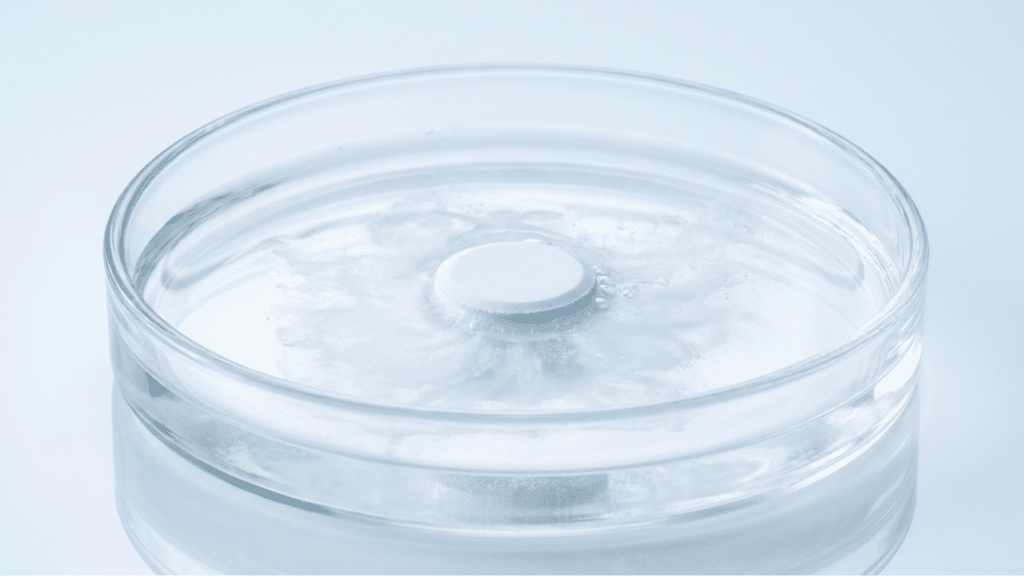
- Dissolution is a kinetic process. It describes the rate at which the API enters solution. Dissolution is influenced by several formulation-related factors, including particle size, surface area, wettability, disintegration behaviour, local pH and the physical environment created by the excipient system.
- Bioavailability refers to the fraction of the administered dose that reaches systemic circulation. It depends on several parameters, including dissolution, permeability, stability in the gastrointestinal tract and first-pass metabolism.
For oral solid dosage forms, the formulation team often acts most directly on dissolution. By selecting appropriate excipients and controlling critical material attributes, formulators can support the conditions needed for consistent API release and dissolution.
How excipients may influence the solubility-dissolution continuum
Excipients can contribute to dissolution performance through different mechanisms. These mechanisms may be physical, chemical or system-level, depending on the formulation strategy.
Physical mechanisms
Particle size reduction is one of the most established approaches. By increasing the surface area of the API, micronization or nanonization may improve dissolution rate, in line with the Noyes-Whitney equation.
Solid dispersion is another approach, where the API is dispersed in a carrier matrix, often in an amorphous state. This can improve apparent dissolution performance, although physical stability and potential recrystallization must be assessed during development and storage.1
Chemical mechanisms
Some excipients may help adjust the microenvironmental pH around the API. This can be relevant for pH-dependent compounds, where local conditions may influence dissolution behaviour.
Cyclodextrins and other complexing agents can also increase the apparent concentration of the API in solution by forming inclusion complexes. In such cases, the effect is not a direct change in intrinsic solubility, but rather an increase in apparent solubilization under specific conditions.
System-level mechanisms
In many oral solid dosage forms, dissolution performance depends on how the full excipient system behaves. Hydrophilic matrices, wetting agents, disintegrants, fillers and binders all contribute to the way water enters the tablet, how the matrix opens and how the API becomes exposed to fluids.
This is why excipient selection is generally considered as part of the overall formulation architecture rather than as a list of individual ingredients.

The role of lactose in dissolution performance
Lactose has a long history of use in oral solid dosage forms, but its selection should always be based on the formulation objective and the characteristics of the API.
For APIs containing primary or secondary amines, compatibility with lactose should be assessed because of the potential for Maillard-type reactions under certain conditions. This does not exclude the use of lactose in all cases, but it means that compatibility testing should be part of development.5
In complex modified-release systems, lactose may have a more limited role if the release kinetics are mainly driven by polymers, osmotic systems or other controlled-release technologies.
Lactose does not modify the intrinsic solubility of the API. Its contribution is generally indirect and formulation-dependent. In immediate-release oral solid dosage forms, lactose can help create favourable conditions for disintegration, wetting and API dispersion.5
Because lactose is water-soluble, it can contribute to the formation of an aqueous phase within the tablet matrix. This may support tablet disintegration and help expose the API surface to gastrointestinal fluids. Its particle characteristics may also influence blend uniformity, compaction behaviour and the reproducibility of the dissolution environment.
Several parameters are particularly relevant:
- Water-soluble filler function. Lactose can dissolve rapidly once water penetrates the tablet, which may support matrix opening and API exposure.
- Wettability contribution. Depending on the formulation, lactose may help distribute water more evenly within the tablet matrix and support contact between the API and the aqueous phase.
- Blend uniformity. For low-dose products, the morphology and particle size distribution of the filler can influence API distribution throughout the blend.
- Batch-to-batch consistency. A well-characterized lactose grade can help reduce variability linked to excipient properties, provided that the formulation and process are also controlled.
These contributions should be validated through formulation trials, dissolution testing and compatibility assessments. Lactose is not a universal solution for all poorly soluble APIs, but it can be a useful and well-understood excipient when selected for a defined technical purpose.
Lactose and MCC: a common combination in tablet formulation
In many oral solid dosage forms, lactose is used in combination with microcrystalline cellulose, or MCC. This association can be relevant because the two excipients bring complementary functionalities.
Lactose is typically valued for its water solubility, good flow properties depending on grade, and its contribution to mouthfeel and tablet matrix behaviour. MCC is widely used for its binding capacity, compressibility and ability to support tablet hardness, particularly in direct compression.5
When used together, lactose and MCC may help balance several formulation objectives:
- Compressibility and tablet strength. MCC can contribute to compactibility, while lactose may support flow and soluble filler functionality.
- Disintegration behaviour. MCC can support water uptake and tablet matrix disruption, while lactose dissolution may contribute to the creation of aqueous pathways within the tablet.
- Processing flexibility. The combination may be relevant in direct compression, dry granulation or wet granulation, depending on the API properties and target tablet characteristics.
- Dissolution environment. For some APIs, the lactose-MCC balance may influence porosity, water penetration and exposure of the API surface.
However, the ratio between lactose and MCC should be defined carefully. A formulation with too much binder-like behaviour may reduce useful porosity, while insufficient mechanical strength may affect tablet robustness. As with any excipient combination, the final choice depends on API properties, target dose, process route and dissolution profile requirements.
API-excipient interactions in the dissolution context
No excipient acts in isolation. The contribution of lactose depends on its interactions with the API and with the other excipients in the formulation.
- Lactose and disintegrants. In combination with disintegrants such as croscarmellose sodium, lactose may contribute to the disintegration-dissolution sequence. The timing and extent of matrix opening should be optimized to support API exposure without compromising tablet robustness.
- Lactose and binders. Binders such as PVP or HPC may improve mechanical strength, but they can also influence porosity and water penetration. The balance between compressibility, hardness and disintegration should therefore be assessed during development.
- Lactose and surfactants. For hydrophobic APIs, surfactants such as sodium lauryl sulfate may support wetting. In such systems, lactose can contribute to the physical matrix and distribution of the API, while the surfactant supports liquid-solid contact.
- Lactose and MCC. The lactose-MCC combination can be useful when formulators need to balance flow, compressibility, disintegration and dissolution performance. The most appropriate ratio should be established experimentally.
The objective is not to identify one excipient as the determining factor, but to build a formulation system that behaves predictably within the intended process and product specifications.
From lab scale to manufacturing: why excipient consistency matters
During scale-up, formulation parameters that appear manageable at laboratory scale can become more visible in production. Blend time, compaction force, granulation endpoint and tablet hardness may all be influenced by excipient variability.
Particle size distribution, moisture content, morphology and flow properties can affect process behaviour and, in some cases, dissolution profile. For this reason, excipient characterization is an important part of formulation development and transfer to industrial scale.4
A lactose grade with controlled and well-documented properties can help formulation teams better understand the contribution of the filler to tablet performance. This does not replace process validation or finished product testing, but it can support a more robust development approach.
Conclusion
Solubility, dissolution and bioavailability describe different but connected dimensions of oral drug performance. Intrinsic API solubility is primarily a chemical property, while dissolution can often be influenced through formulation design. Bioavailability is the downstream result of several factors, including dissolution and permeability.
In this context, excipients should be considered as functional components of the formulation. Lactose can support immediate-release oral solid dosage forms through its water solubility, filler function, contribution to disintegration behaviour and compatibility with established formulation strategies such as lactose-MCC combinations.
Its role should be understood as indirect, but technically relevant. When selected with the right grade, properly characterized and evaluated through formulation trials, lactose can contribute to a more consistent dissolution environment and support the development of robust oral solid dosage forms.
For formulation teams, a science-based approach to excipient selection, grounded in a clear understanding of each component’s functional contribution, can support more reproducible formulation outcomes and a more robust development pathway.
FAQ: Solubility and excipients, what R&D teams often ask
Why are many APIs associated with limited aqueous solubility?
Many modern drug candidates are designed to interact with complex biological targets. This can lead to molecules with higher lipophilicity and lower aqueous solubility. Formulation strategies may help support dissolution performance, but the most appropriate approach depends on the API, target dosage form and intended release profile.
Can excipients improve API solubility?
Excipients do not usually change intrinsic API solubility. However, they can influence apparent solubilization, wetting, disintegration and dissolution rate. Examples include complexing agents, surfactants, solid dispersion carriers, pH modifiers and soluble fillers such as lactose.
What role can lactose play in oral tablet dissolution?
Lactose can contribute indirectly to dissolution performance by supporting tablet matrix behaviour, water penetration, disintegration and API exposure. Its contribution depends on the lactose grade, the API properties, the other excipients used and the manufacturing process.
Why is lactose often combined with MCC?
Lactose and MCC are often combined because they bring complementary properties. Lactose can provide soluble filler functionality and flow, while MCC supports compressibility and tablet strength. The combination may help balance processing, disintegration and dissolution requirements.
What should be considered when selecting a lactose grade?
Key parameters include particle size distribution, flowability, compressibility, moisture content, process compatibility and the intended dosage form. Compatibility with the API should also be assessed, particularly for APIs that may be sensitive to Maillard-type reactions.
What is the difference between solubility, dissolution and bioavailability?
Solubility is the maximum amount of API that can dissolve under defined conditions. Dissolution is the rate at which the API enters solution. Bioavailability is the fraction of the administered dose that reaches systemic circulation. Formulation teams most often act on dissolution to support product performance.
Sources
- Hashim F. et al. “Advancement in Solubilization Approaches: A Step towards Bioavailability Enhancement of Poorly Soluble Drugs.” Pharmaceutics, MDPI, 2023. PMC10221903. DOI: 10.3390/pharmaceutics15071916.
- Agno Pharmaceuticals. “Biopharmaceutical Classification System Technical Brief.” BCS Class II NCE progression: 30% to 60%.
- FDA. “Guidance for Industry: Waiver of In Vivo Bioavailability and Bioequivalence Studies for Immediate-Release Solid Oral Dosage Forms Based on a BCS.” CDER, 2017.
- Murray JD et al. “Advancing algorithmic drug product development: Recommendations for machine learning approaches in drug formulation.” European Journal of Pharmaceutical Sciences. 2023;189:106562. DOI: 10.1016/j.ejps.2023.106562.
- Rowe RC et al. Handbook of Pharmaceutical Excipients, 8th edition. Pharmaceutical Press, 2017. Lactose monograph.