
Producing Pharmaceutical-Grade Lactose: Lactalis’ Energy Challenges and Environmental Commitments
We organized an exclusive Q&A session with Maeva Croué — CSR Coordinator for Lactalis Ingredients Pharma.

Meet the Expert: Maeva Croué
Maeva is the Product Manager at Lactalis Ingredients Pharma. With extensive expertise in pharmaceutical excipients and product development, she plays a key role in ensuring the quality, reliability, and innovation of Lactalis’ pharmaceutical lactose solutions.
This interview highlights three aspects of sustainable development:
🌱 Our environmental and social commitments
♻️ The carbon footprint of pharmaceutical lactose
💧 Our responsible and optimized approach to water management
Below you will find the the video of the interview and its transcript; focusing on our environmental and social commitments.
How does Lactalis integrate environmental and social challenges into its strategy, and what concrete actions are being taken to support the sustainable transition of the dairy sector?
For several years, environmental and social issues have been embedded in our corporate policy.
- ESG governance reports directly to our CEO. These issues carry even more meaning for us as a family‑owned, global company with more than 85,000 employees operating across over 50 countries. From an environmental standpoint, the dairy industry requires particular attention, as it is a significant emitter of greenhouse gases, primarily due to methane linked to enteric emissions from dairy cows, in addition to other impacts such as animal welfare, biodiversity, and deforestation.
- In 2025, this translated into the introduction of a premium for dairy farmers, designed to encourage the adoption of more sustainable agricultural practices. In collaboration with one of our customers, we are also conducting an experimental project involving around one hundred farms to study the levers for reducing greenhouse gas emissions at farm level.
How do you ensure the credibility and monitoring of your environmental commitments for 2030?
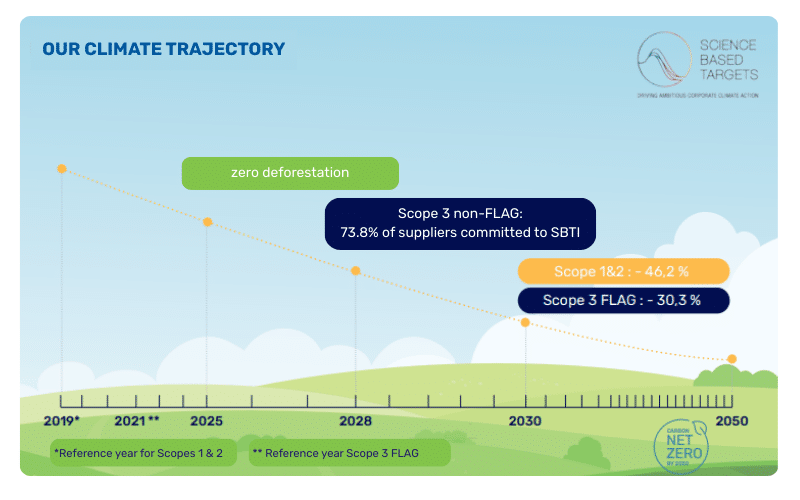
As a reminder, Lactalis’s environmental commitments were validated by the SBTi in July 2024. We aim to reduce our GHG emissions by 30% for Scope 3 and 46% for Scopes 1 and 2 by 2030. This places us on a trajectory aligned with limiting global warming to below +2°C by 2100, in line with the Paris Agreement.
How is pharmaceutical lactose produced, and what are the key energy and environmental challenges associated with its manufacturing?
Lactalis Ingredients Pharma produces pharmaceutical‑grade lactose, an excipient derived from milk—more specifically from whey or permeate. Producing pharmaceutical lactose involves several industrial steps, including concentration and crystallization, which enable the transition from a liquid phase to a solid phase. For example, producing 1 kg of lactose requires around 14 liters of liquid whey upstream, 90% of which is water. Heating and concentrating to separate water from dry matter are energy‑intensive steps, but they also offer significant opportunities to recover and reuse the water generated throughout the process.
Pharmaceutical lactose production is energy‑intensive. What investments have you made to reduce your energy consumption and optimize water recovery or recycling within your processes?
For Lactalis Ingredients Pharma, our industrial footprint is a key area of focus, as producing dairy ingredients—transforming a liquid phase (milk) into a solid phase (the ingredient)—requires significant amounts of energy. Specifically, in pharmaceutical lactose production, heating and concentration processes are required to separate water from dry matter.
In 2025, we invested nearly 15% of our annual budget in projects aimed at reducing our energy consumption—and thus our emissions—as well as in technologies enabling us to save, recover, and recycle water within our processes.
Minimizing our environmental impact by optimizing our processes helps ensure the long‑term sustainability of our operations. Environmental considerations shape our strategy and investment decisions, driving us to innovate differently and embed our company within a model of responsible and sustainable growth.
Maeva CROUE
CSR Coordinator for Lactalis Ingredients Pharma