
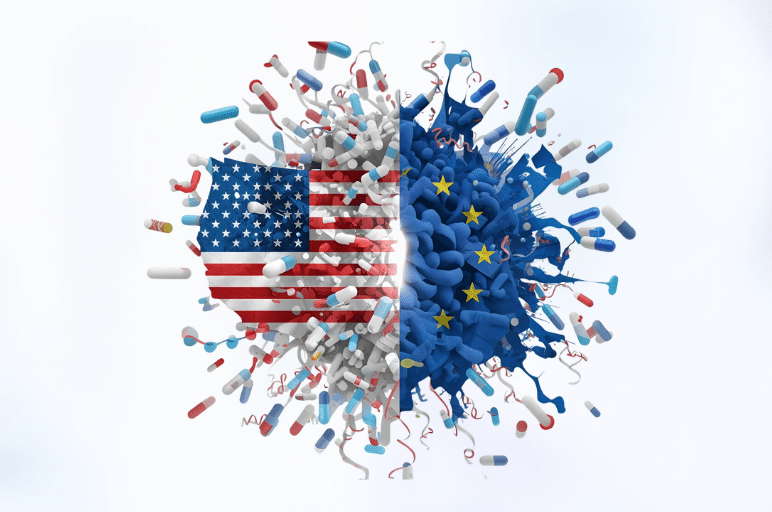
Trump’s Tariffs and the Future of Pharma: A Geopolitical Turning Point for the Global Industry
As Donald Trump returned to the White House in January 2025, few expected his administration to disrupt the global pharmaceutical industry so swiftly and profoundly. Within months, a series of bold announcements—centered on steep import tariffs and aggressive drug pricing demands—ignited a chain reaction that is transforming global supply chains, reshaping investment strategies, and raising serious questions about the future of pharmaceutical innovation, especially in Europe.
A Protectionist Turn with Global Implications
In September 2025, Trump announced a 100% tariff on all branded and patented pharmaceutical imports into the U.S., effective October 1st, unless the manufacturer established a domestic production site. Generic drugs, representing roughly 90% of U.S. prescriptions, were exempted.
This unilateral move blindsided many, especially as it followed a recent EU-U.S. trade agreement that had capped pharmaceutical duties at 15%. The Trump administration’s justification: U.S. citizens are unfairly subsidizing global pharmaceutical R&D, paying much higher prices than European counterparts.
Simultaneously, 17 major drugmakers—including Pfizer, AstraZeneca, Novartis, and Sanofi—received letters demanding they slash their U.S. prices by up to 90%, under threat of sweeping regulatory and trade reprisals. Trump’s rationale relied on the “most favored nation” pricing clause, aiming to align U.S. prices with the lowest available globally. This policy stance echoed earlier sentiments regarding pharmaceutical pricing, where market expectations during a previous Trump presidency anticipated deregulation that would favor increased drug costs.
“Americans are financing global innovation alone. This stops now.”
— Donald Trump, September 25, 2025
Source: Le Monde
U.S. Trade Deficit Falls to Lowest Level in 16 Years
The US trade deficit fell to a historic low in October, dropping to $29.4 billion, its lowest level since mid-2009. This 39% drop from the previous month surprised analysts.
This improvement is due to an increase in exports (+2.6%) and a decrease in imports (-3.2%), particularly pharmaceutical products (- $14.9 billion). Tariff measures introduced earlier in the year and adjustments to global supply chains are playing a key role in this development.
Highlights include:
- Imports from Ireland fell by $15.1 billion, reflecting the decline of pharmaceutical giants.
- The deficit with the European Union narrowed to $9.7 billion, while those with Mexico, Taiwan, and Vietnam continue to grow.
- China remains a major player with a deficit of $13.7 billion, ranking fourth among deficit partners.
This trend could mark a turning point for US trade policy, against a backdrop of changing global flows and readjusting demand patterns.
Trump’s Shock Doctrine: Pharma Capitulates and Shifts Capital Stateside
The threats proved effective. Within weeks, leading pharmaceutical companies unveiled over $350 billion in new investment commitments for U.S.-based manufacturing and R&D facilities.
- Pfizer committed $70B and received a 3-year customs exemption.
- AstraZeneca pledged $50B by 2030, building a new center in Virginia.
- Merck KGaA secured tariff relief in exchange for 84% price cuts on fertility drugs.
- GSK, J&J, Eli Lilly, BMS and others followed suit with multi-billion-dollar domestic expansion plans.
- Sanofi plans to invest over €17 billion in the U.S. over five years, strengthening its industrial and R&D footprint. About $1 billion will expand its development platform as it relocates from Bridgewater to Morristown, NJ, transferring 1,900 employees. Focused on biopharmaceuticals, this initiative is part of the $20 billion Sanofi pledged by 2030 under Trump administration pressure. The company, which earns 49% of its sales in the U.S., will significantly boost R&D and U.S. production investments.
This “rush to reshore” is not merely symbolic. The capital influx is altering production maps, creating thousands of U.S. jobs, and furthering the shift away from Europe and Asia.
Beyond capital reallocation, a critical question emerges for Europe’s long-term pharmaceutical sovereignty: what happens to excipient sourcing if large pharmaceutical companies transition key manufacturing platforms to the U.S.? Many excipients—including pharmaceutical-grade lactose—have traditionally been produced in Europe, benefiting from a stable regulatory environment and reliable quality systems. If production migrates overseas, local excipient manufacturers could face reduced demand or pressure to follow their customers abroad, potentially weakening Europe’s industrial base and diminishing its ability to maintain secure, high-quality supply chains. This risk is amplified by the fact that companies like Sanofi and AstraZeneca generate more than half of their revenue in the U.S., making relocation incentives particularly compelling. Moreover, Trump’s administration frames American pharmaceutical R&D as disproportionately subsidizing global innovation, with other nations, particularly European Union members, benefiting from access to new drugs without contributing equitably to the development costs.
Europe: A Continent at Risk
The European Federation of Pharmaceutical Industries and Associations (EFPIA) warned in April 2025 that without a “radical policy response,” Europe could lose over €100 billion in planned pharma investments. An internal EFPIA survey among 18 major European pharma CEOs revealed alarming trends:
- Up to 85% of capital investments planned for the EU (2025–2029) are now “at risk” of relocation. This includes not only final-dose manufacturing but also upstream activities tied to raw materials and excipients, raising structural risks for European suppliers whose customers may progressively shift their purchasing footprint to U.S.-based facilities.
- Nearly 50% of R&D budgets could shift to the U.S.
- Delays or cancellation of clinical trials and new launches in Europe are becoming more likely.
The Czech Republic and European Parliament have begun counter-initiatives, such as the “Choose Europe” program (2025–2027, €500 million), offering incentives for domestic trials and longer data protection.
But will these be enough?
Drug Pricing Domino Effect
The “America First” approach to pricing doesn’t just impact U.S. patients or companies. By pushing down U.S. prices, it increases the likelihood of higher prices—or launch delays—in other regions.
Alexander Natz of EUCOPE warned:
“The U.S. price reform may look national, but its consequences are global.”
Source: Geneva Health Files
With France often cited as having Europe’s lowest drug prices—sometimes four times below U.S. levels—it is particularly exposed. Several analysts forecast a potential strategy shift: companies may raise EU prices or deprioritize European launches to maintain global profitability. This dynamic could further erode Europe’s attractiveness as a launch market, compounding the risk of industrial and R&D disinvestment that already threatens excipient and ingredient suppliers dependent on proximity to formulation sites.
Towards a New Global Technological Balance?
Interestingly, while the short-term shock appears negative for global pharma equilibrium, there may be some unintended positive outcomes in the medium term—particularly for innovation hubs willing to adapt.
U.S. regulatory agencies have introduced fast-track mechanisms and AI-friendly frameworks. Trump’s administration announced “no-regulation zones” for AI in medical R&D, aiming to make the U.S. a global AI healthtech leader by 2027. The FDA, CMS, and NIH are aligning on shared datasets and accelerated review processes for advanced therapeutics.
Meanwhile, countries like Germany and the Netherlands are experimenting with public-private partnerships to retain high-value pharma activities. If executed swiftly, these shifts could drive a smarter distribution of global innovation centers—less reliant on historical manufacturing hubs, more focused on agility and resilience.
Looking Ahead: Challenge or Catalyst?
The Trump administration’s aggressive trade and pricing stance has catalyzed a historic redistribution of pharmaceutical capital and capabilities. The impact on global innovation is twofold:
- Risk: Europe’s leadership in life sciences could erode under pressure from U.S. relocation incentives and price compression. This erosion would not only affect R&D and finished drug manufacturing but also the upstream ecosystem of excipient producers. European suppliers—valued globally for their regulatory reliability, sustainable sourcing models, and technical expertise—could face declining demand or pressure to shift production closer to newly established U.S. pharmaceutical hubs. If formulation, tableting, and OSD production lines are progressively relocated, Europe risks losing strategic industrial capabilities and weakening its control over critical inputs such as pharmaceutical lactose.
- Opportunity: The policy shock may force a necessary recalibration—pushing the EU and Asia to modernize regulatory frameworks, invest in competitive infrastructure, and rethink value-based pricing.
In short, 2025 could mark a turning point not just for the U.S. pharmaceutical industry, but for the entire global ecosystem. The industry is entering a more fragmented, politically charged, but potentially more innovative era.
Frequently Asked Questions (FAQ)
1. Why did Trump impose tariffs on pharmaceutical imports in 2025?
To reduce U.S. drug prices and force pharmaceutical companies to relocate production to the U.S., Trump imposed 100% tariffs on branded imported drugs. This was part of his “America First” strategy to address what he called the unfair burden on U.S. consumers.
2. How are pharmaceutical companies responding to Trump’s policies?
Major players like Pfizer, AstraZeneca, Sanofi, and others committed hundreds of billions of dollars in U.S. investments to avoid tariffs and maintain access to the U.S. market.
3. What does this mean for European pharmaceutical innovation?
Europe risks losing capital, clinical trials, and strategic manufacturing to the U.S. unless it strengthens its investment incentives, regulatory frameworks, and industrial resilience.
4. How could lower U.S. drug prices affect pricing in the rest of the world?
By compressing U.S. prices, pharmaceutical companies may seek to rebalance margins by increasing prices elsewhere or delaying launches in lower-priced regions such as Europe. This could reduce Europe’s access to innovative therapies and further weaken its strategic position in the global pharmaceutical landscape.
References:
- Le Monde (2025): Droits de douane – Trump frappe la pharma
- Actulabo (2025): L’effet Trump sur la pharma mondiale
- EFPIA: Pharma CEOs alert to risk of exodus to the US
- Geneva Health Files: Geopolitics and pharma investments
- Numerikare: U.S. plans for AI zones in medtech
- Reuters: Bristol Myers investment
- France info: Sanofi investira 17 milliards en 5 ans
- BFM TV: Du jamais vu depuis juin 2009 le deficit commercial des états unis a atteint en octobre son niveau le plus bas en 16 ans